
Newborn and Baby Care
Good baby care matters for a baby's health, everyday comfort and behaviour. The skin is one of a newborn's first points of contact with the outside world, and its appearance and condition can offer useful clues about the child's health.
In this article
Delicate skin needs special care
A newborn's body is still immature, and this is particularly apparent in the skin. It is several times thinner than adult skin, while the sebaceous glands are not yet fully developed and do not produce enough oil. The protective keratin layer, which helps maintain the skin barrier, is also underdeveloped.
At the same time, a baby's skin comes into contact with urine, stools and moisture every day, and is also vulnerable to drying out. Good hygiene therefore involves both removing dirt and preserving the skin's natural protection.
Bathing, changing and other care routines also give parents and babies a chance to bond. Gentle touch, a calm voice, talking and play can turn everyday tasks into enjoyable moments together.
Getting ready for your baby's bath
Before starting the bath, have everything you will need ready so that you can care for your baby calmly, without interruptions or unnecessary rushing.
Keep a large, soft towel to wrap your baby in within reach, along with mild baby soap if you are using it, a soft wash mitt or washcloth, clean cotton wool, saline solution, barrier cream, clean clothes and nappies. Do not reuse cloths or other materials intended for single use.
Being well prepared allows you to stay with your baby and give them your full attention throughout.
Bath time is about more than keeping clean. It can include gentle touch, massage, play, nail care and, when needed, a hair trim. These moments offer a chance to bond, get to know each other and enjoy communicating.
Your newborn's first bath
Your baby has their first full bath after the umbilical cord stump has fallen off and the area has healed.
Until then, keep your baby clean each day by washing one part of the body at a time on a suitable surface. This allows you to keep your baby clean without immersing their whole body in water.
Wash gradually, starting with the head and face, including the eyes, ears, nose and skin folds around the neck, before moving on to the navel and nappy area.
Be gentle throughout and keep the time your baby spends uncovered to a minimum.
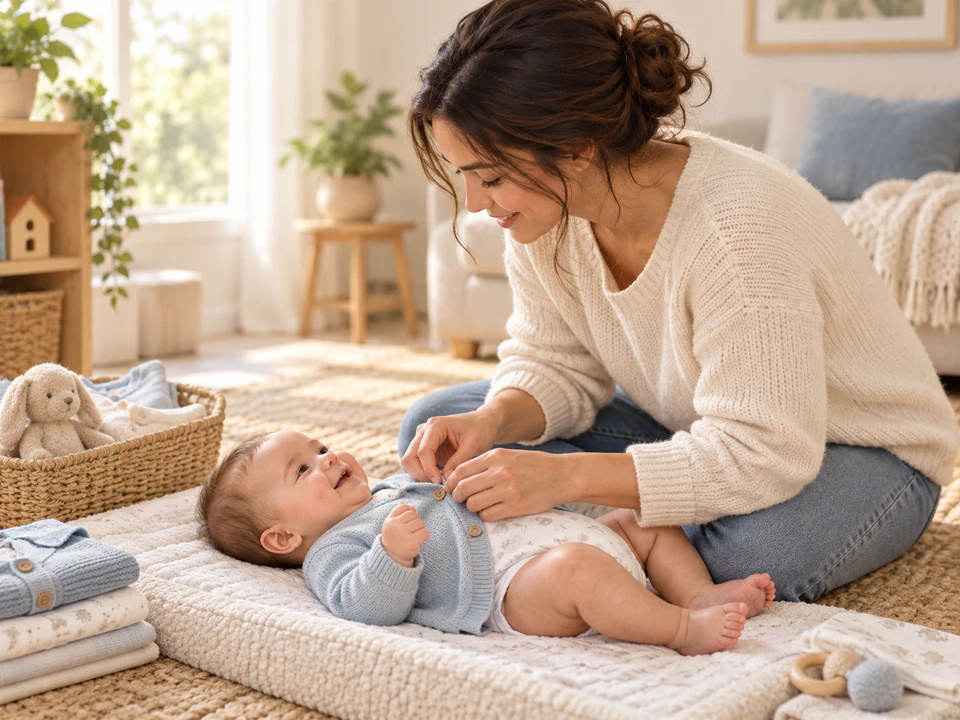
Washing your baby on a changing mat
You can use a soft terry wash mitt soaked in warm water. Lay your baby on a suitable, stable changing surface covered with a soft cotton nappy.
Start by gently cleaning the eyes. Wipe the damp mitt across the eyelids from the outer corner towards the inner corner of each eye. Then wash the rest of the face and carefully pat it dry with a towel.
During the first three months of life, water is enough for bathing a newborn or young infant. Special baby soaps are used mainly to clean the nappy area.
If you do use soap, adapt the washing routine to your baby's sensitive skin.
Support your baby's body and head with one hand, and gently wash them with a soft mitt using the other. After washing the head, rinse away any soap residue and dry it carefully.
Next, wash the neck, chest, arms and legs. Covering the parts of the body you are not washing with a towel helps keep your baby warm. If you have used soap, rinse it off thoroughly and gently pat the skin dry.
To wash the back of the body, carefully turn your baby over and briefly lay them on their tummy, keeping them supported at all times. Wash the back of the neck and the back, then rinse and dry the skin.
Once the umbilical area has healed, small clothing fibres and other debris can collect in the navel. These can be carefully removed with a cotton bud and saline solution.
Finally, turn your baby onto their back again, remove the nappy and clean the genitals and bottom.
Cleaning the genitals and nappy area
Clean the genitals and bottom carefully, bearing in mind the sensitivity of the skin and the possibility of transferring microorganisms.
Wash the genitals first and the bottom last. This order is particularly important because of the bacteria naturally present around the anus.
Genital care for baby girls
When cleaning a baby girl, you may notice a build-up of shed skin cells between the outer labia. Gently clean this area with sterile gauze or soft cotton wool soaked in plain water or a suitable cleansing milk.
Always wipe from front to back, from the genitals towards the bottom. Use a fresh piece of gauze or cotton wool for each stroke.
Cleaning this way reduces the chance of transferring bacteria from around the anus to the opening of the urethra, and therefore the risk of bacteria entering the urinary tract.
Genital care for baby boys
In boys, whitish deposits known as smegma can sometimes be seen beneath the foreskin of the penis, also called the prepuce. They may look like small white bumps under the skin.
Care involves gentle washing with water and removing any dirt that can be reached without applying force.
Only move the foreskin as far as it moves naturally and without resistance. Do not pull it back forcibly or try to separate areas that have not yet separated naturally.
After the first birthday, if the foreskin pulls back easily, water and mild soap can be used for cleaning. The foreskin gradually becomes more mobile, and in many boys full retraction may become possible around the age of five.
Cleaning your baby's bottom
Wash the bottom last, paying particular attention to skin folds where traces of stool may remain.
Wash and rinse from the genitals towards the bottom, then carefully pat the skin dry.
It is especially important not to leave the area around the anus and genitals damp, as lingering moisture can encourage skin irritation.
Bathing your baby in a baby bath
A roomy baby bath with a flat base is a practical choice, giving your baby more freedom to move and a more comfortable experience in the water.
Before lowering your baby into the bath, have all care products and supplies ready within reach.
Never leave your baby alone in the water. An adult must stay right beside the baby and keep them securely supported throughout the bath.
Once the umbilical area has healed, your baby can be immersed in a baby bath. Support the head and neck with one hand while washing with the other. Immerse the body sufficiently to keep your baby comfortable, while securely holding the head above the water.
Wash from the head down towards the lower parts of the body.
Pay particular attention to the neck folds, armpits, back, tummy and legs. Wash between the toes and in the folds behind and below the knees too.
After the bath, dry the skin carefully, starting with the head and behind the ears, then the neck and armpits, and finally the groin, legs and bottom.
Bath water temperature
Babies are usually comfortable in water close to body temperature, between 36 and 37 °C.
You can check the temperature with a bath thermometer. If you do not have one, dipping your elbow into the water gives a rough idea of how warm it is.
Water that feels a little cooler to an adult at first touch may be close to a baby's body temperature. Water that is too warm is undesirable, and a large difference between the temperature of the bath and the surrounding air can make your baby uncomfortable when lifted out.
Room temperature
The room where you bathe your baby should be warm enough to prevent sudden cooling when they come out of the water.
A room temperature of approximately 24 °C, or around 22–23 °C, is suggested for keeping your baby comfortably warm during bathing.
This is particularly important in winter, especially in homes where a baby is carried from a warmer bathroom into a much cooler room after a bath.
Once the care routine is finished and you begin dressing your baby, the bathroom door can be opened briefly to allow the temperature to move gradually closer to that of the room where your baby usually spends time or sleeps.
For everyday room temperature, the suggested range is 18 to 21 °C.
How often should you bathe a newborn or baby?
Baths do not need to be long during the first few weeks. About five minutes may be enough to keep your baby clean.
As your child grows, bath time can become an increasingly enjoyable part of the daily routine, with play and exploring the water, so baths can gradually become longer.
Skin is more prone to drying out in the colder months, so full baths are recommended less often than during periods when the skin is less exposed to dry air.
However often your baby has a bath, the nappy area needs regular cleaning at changes.
What if your baby cries during a bath?
Some babies do not enjoy being in a baby bath straight away. If your baby starts crying or seems very uncomfortable, try to stay calm.
Wash your baby as much as the situation allows, then carefully lift them out of the water, wrap them in a towel and hold them close.
For the next few days, you can keep your baby clean by washing them on a changing mat with a soft, damp wash mitt or washcloth.
You can then try a bath again.
It is important that bath time does not become something your baby associates with excessive distress.
When is the best time to bathe your baby?
There is no single time of day that suits every baby.
Bath time can fit around your family's habits, daily routine and your baby's mood.
For some families, an evening bath is a pleasant way to end the day. Warm water, gentle touch and a calm atmosphere can help a baby relax and get ready for sleep.
For some babies, this routine may also be associated with more restful sleep.
When can you introduce showers?
Showers can be introduced gradually once your baby begins sitting independently, which usually happens between six and nine months of age.
Your baby's first experiences of the shower spray should be especially gentle so that it does not frighten them.
Like bathing, showering should be enjoyable. If your baby seems frightened or protests strongly, do not insist on continuing.
Towels and wash mitts
A large, soft towel that can wrap around your baby's whole body after a bath is the most practical choice.
Towels and wash mitts should be made from soft materials, such as cotton or linen, and be suitable for thorough washing, boiling and ironing.
A soft terry wash mitt or a suitable piece of fabric is practical for everyday cleaning.
Sponges can feel pleasant when used to apply water to the skin, but their structure makes it difficult to remove all the dirt trapped inside them. Wash mitts or soft pieces of terry cloth are therefore preferable.
Care supplies should be for your baby's use only; towels and wash mitts should not be shared with other household members.
Keeping them clean and dry is especially important. Damp towels and wash mitts can encourage bacteria and fungi to multiply, so they need to be changed regularly and kept clean.
Skin care after a bath
After a bath, dry your baby's skin thoroughly but gently.
Newborns need particular care, especially during the first month of life, because their skin is very sensitive to moisture and the irritating effects of urine and stools.
Dry the skin folds in the armpits, around the neck, in the groin and anywhere else skin touches skin thoroughly. Warm, damp areas can encourage fungal growth and inflammation.
Once the skin is dry, apply a suitable barrier cream to the nappy area. Adapt care to other sensitive areas too, including skin folds and the skin around the ears.
A thin layer of baby oil can be applied to carefully dried skin folds to reduce friction between skin surfaces and the likelihood of irritation.
Prompt nappy changes are just as important, as prolonged skin contact with stools and urine increases the chance of irritation.
Caring for your baby's hands and nails
The skin on children's hands is prone to drying out, so a panthenol-based cream can be applied after washing.
A newborn's nails are very small and soft, but they can grow quickly.
Regular trimming is not always necessary during the first few months. The soft tips of growing nails can sometimes be carefully peeled away.
When trimming is needed, use special baby scissors with rounded tips. Cut the nails straight across and not too short.
As your child grows, nail care becomes a regular part of the weekly hygiene routine.
Occasionally, a nail grows into the surrounding skin, which can cause redness and swelling at the tip of the finger. Mild cases may settle on their own over time without specific treatment.
Cleaning your baby's ears
Ear care involves cleaning the visible outer ear, or pinna, and the area behind the ear.
After washing, it is especially important to dry the skin behind the ears thoroughly, as moisture can collect there.
Do not try to clean inside the ear canal, also called the external auditory canal, with cotton buds or other objects.
Although cotton buds may seem harmless, inserting them into the ear canal can cause injury.
Cleaning your baby's nose
To remove small amounts of debris from the nose, you can roll a small piece of cotton wool for each nostril.
Moisten the cotton wool with saline solution; a suitable seawater nasal spray is another option.
Gently place the prepared cotton wool just inside the nostril and carefully rotate it to remove debris from the accessible part of the nasal lining.
Repeat for the other nostril, using a separate, clean piece of cotton wool.
Cleaning your baby after a bowel movement
After your baby passes a stool, it is best to clean any soiled skin as soon as possible.
You can wash the area under lukewarm running water. Take particular care to clean the folds and the skin around the anus and genitals, then dry the skin carefully.
Wipes without alcohol or strong fragrances can be a practical alternative, especially after the first month of life.
Regular cleaning and prompt nappy changes help prevent prolonged skin contact with urine and stools.
Common skin changes in newborns
Various changes can appear on a baby's skin during the first few months of life. Many are temporary and clear up on their own, while some need additional care or professional assessment.
Milia and newborn acne
Milia are tiny whitish or yellowish bumps on the skin. They form when small amounts of skin material become trapped in shallow pockets beneath the skin's surface.
Acne usually appears as more noticeable red or white spots, and its development is associated with sebaceous gland activity and hormonal changes.
Many babies have milia at birth, while others develop them during the first three to four weeks of life. Milia are equally common in girls and boys, while newborn acne is slightly more common in boys.
There is no reliable way to prevent them, but they usually clear up on their own.
There is no need to scrub the skin or apply products simply to get rid of these changes, as doing so can cause further irritation.
If the acne has not cleared up during the first three months of life, talking to a doctor is recommended.
Nappy rash
Nappy rash is a common form of skin inflammation, or dermatitis, in the area covered by a nappy.
It can occur throughout infancy and is often seen between eight and ten months of age.
Several factors can contribute to its development. These include a fungal infection of the mouth known as oral thrush, antibiotic use and changes after the introduction of complementary foods.
Thrush can be recognised by whitish patches on the tongue and the lining of the mouth.
Other factors that can contribute to nappy rash include new laundry detergents, tight nappies that rub, infrequent nappy changes, diarrhoea and the use of plastic pants.
When the skin's protective function is compromised, secondary fungal infections, and sometimes bacterial infections, can develop.
How to care for skin with nappy rash
With nappy rash, more frequent nappy changes, careful cleaning and thoroughly drying the skin are especially important.
If the skin is very red and irritated, compresses soaked in saline solution can be used.
It also helps to leave your baby without a nappy from time to time so that the skin is exposed to the air. Make sure the room is at a suitable temperature.
Moisture and warmth create favourable conditions for fungal growth, including Candida albicans, which may be naturally present on the skin and mucous membranes.
If the inflammation does not settle, a secondary fungal infection may have developed. In more pronounced cases, seek advice from a health visitor or paediatrician, who can assess whether a cream for a fungal or bacterial infection is needed.
Suitable antifungal products can help symptoms resolve when a fungal infection is the cause.
Heat rash
A rash associated with overheating usually appears as small, pale or pink marks on the skin.
It is most often seen on the forehead, face, neck folds, chest and arms.
It is often linked to keeping a baby too warm or dressing them in too many clothes, which is why it is more common in the summer months.
This type of rash usually clears up on its own and does not need specific treatment.
Cradle cap in babies
Cradle cap is common in infants and is caused by increased activity of the sebaceous glands.
Thin or thick layers of greasy scales form on the scalp and may cling firmly to the skin's surface.
Cradle cap is not a sign of poor hygiene and is not considered a disease, but a common physiological change during infancy.
Keeping the area clean is still important, as scratching and damage to the skin can encourage microorganisms to multiply and infection to develop.
How to soften and remove cradle cap
Products such as olive oil or almond oil can be used to soften the build-up.
Olive oil lubricates and cleanses the scalp, which can help loosen the crusts.
You can carefully apply oil to the affected areas with oil-soaked cotton wool about thirty minutes before bathing.
If the build-up covers the whole scalp, oil can be applied in the evening and the head covered with a cotton cap to let it work overnight.
The softened scales can then be gently removed with a hairbrush or fine-toothed comb before washing the head.
There is no reliable way to prevent cradle cap, and some children are more prone to it than others.
If it persists or the skin becomes red, an antifungal scalp cream is sometimes needed.
Cleaning your baby's mouth
Caring for your baby's mouth becomes especially important when the first teeth begin to come through and complementary foods are introduced.
Initially, sterile gauze can be used to gently remove food residue.
Soft baby toothbrushes are introduced later, with use suggested after eighteen months of age.
Choosing skin care products for your baby
The skin of newborns and infants is especially sensitive, so care products need to be chosen thoughtfully.
Parents often want their baby to be clean, well cared for and pleasantly scented. Manufacturers respond with a wide range of products in different fragrances, colours, formulations and packaging.
However, attractive packaging and a strong fragrance are not reliable signs of quality.
A baby's skin has a relatively large surface area in relation to body weight, and its permeability differs from that of adult skin. Products that come into direct contact with it therefore need to be chosen carefully.
Cosmetic products do not undergo the same testing and approval processes as medicines, which is another reason to choose carefully.
When buying products, consider the manufacturer's reliability, manufacturing standards and the ingredients.
Products with simpler formulations are preferable, without unnecessary additives used mainly to provide colour or fragrance.
Soaps and gentle cleansers
In the earliest stage of life, the skin can be cleaned with water and saline solution, while soaps and shampoos can be introduced later.
When using a cleanser, its pH, or level of acidity, matters.
Neutral or mildly acidic products with a pH of approximately 5.5 are recommended for infant skin care; this is usually shown on the packaging.
Syndets, or synthetic cleansers, offer an alternative to traditional soaps.
They can remove dirt effectively, and their benefits include stability in hard water, lower pH levels and better tolerance by sensitive skin.
They may be particularly useful for skin prone to chronic eczema.
Shampoos and bubble baths
Most babies do not need their hair washed regularly with shampoo during the first year of life.
If your baby has thicker hair or there is a particular reason to use shampoo, you can choose a mild baby shampoo without synthetic fragrances, colours or highly irritating preservatives.
Shampoo is more often introduced after six months, when hair becomes thicker and growth is more noticeable.
Gentle products that do not irritate the eyes are particularly suitable.
Bubble baths are not recommended for very young babies. They may contain detergents that strip away the skin's protective acid mantle and affect its natural bacterial flora.
These products can contribute to irritation in sensitive areas, including inflammation of the genitals and urinary system.
They are intended for use only later, during the second year of life.
Baby oils
Baby oils are used mainly to cleanse and care for the skin.
Natural oils include peanut oil and wheat germ oil, which contain essential fatty acids.
They can help remove dirt and form a thin protective layer on the skin's surface.
Baby wipes
Baby wipes are a practical option for everyday care, especially during nappy changes.
They may contain ingredients that gently cleanse the skin, along with natural oils intended to protect against dryness and irritation.
Some products contain panthenol, also known as provitamin B5, which is used in products to support the repair of damaged skin.
When choosing wipes, avoid those containing alcohol or strong fragrances.
Barrier creams for the nappy area
Barrier cream is designed to care for skin exposed to urine and stools every day.
Apply a thin layer to skin that has already been cleaned and dried.
Quality products may contain protective ingredients such as titanium oxide, as well as panthenol, which is used to support skin repair.
Face and hand creams
The skin on the face and hands is exposed to the elements all year round.
Suitable baby creams can help reduce dryness and protect the skin from cold, wind and the effects of sunlight.
Their use is not limited to winter or periods of marked changes in the weather.
Why is baby powder used less often?
As other care products have been developed, baby powder, or talc, has become less prominent in everyday baby hygiene.
A particular concern is the possibility of inhaling it during application, especially when powder is scattered around the neck, armpits and other skin folds.
Inhaling talc particles is considered harmful.
Caring for skin prone to atopic dermatitis
Babies prone to chronic eczema, also called atopic dermatitis or neurodermatitis, need particular care when bathing and choosing products.
For this type of skin, bathing is recommended no more than twice a week, with suitable products added to the water to reduce drying.
A suitable protective product needs to be applied after bathing.
It is best to choose products in line with your paediatrician's recommendations.
Ingredients to look out for
When choosing baby skin care products, check the ingredients rather than relying solely on appearance, fragrance or popularity.
Particular caution is recommended with unnecessary artificial colours and fragrances, and with ingredients that may irritate sensitive skin.
Substances to look out for include DEA and TEA, certain preservatives such as parabens, quaternium-15 and imidazolidinyl urea, as well as menthol, peppermint and citrus additives.
For products that protect against ultraviolet radiation with an SPF of 15 or higher, formulations based on mineral filters such as titanium dioxide and zinc oxide are preferable, because some chemical filters may cause irritation.
Caution is also recommended with products containing mineral oils, also known as paraffin oils.
With lanolin, particular attention needs to be paid to the purity of the raw material and possible pesticide residues, including DDT, lindane and diazinon.
Antibacterial soaps are generally not recommended for routine care of children's skin.
Staying with products that suit your baby
When buying baby skin care products, it is best to choose quality products from reliable manufacturers that follow appropriate manufacturing standards.
Get to know the ingredients and choose products suited to your child's sensitive skin.
If a product suits your child and gives satisfactory results, there is no need to change it simply because a newer product with more attractive packaging or fragrance has come onto the market.