The Bond Between Mother and Baby
Babies begin getting to know people long before they understand words. Being fed, changed, carried or settled to sleep gives them countless small experiences of what it means to be with another person. Affection, attention and a response to their needs are not extras that come once the practical care is finished: they are part of that care. Through these repeated encounters, closeness develops, along with the expectation that someone will help when things feel difficult. A mother's emotional bond with her baby and a baby's attachment to a caregiver are closely related, but they describe different experiences. Bonding concerns the mother's feelings about the relationship; attachment is the relationship through which the child seeks protection, comfort and security. Neither has to emerge all at once or follow a fixed timetable. Mothers often play a central part, but babies can also build close, dependable relationships with their fathers and other people who regularly care for them.
In this article
What babies pick up in everyday contact
A newborn cannot yet understand a sentence, but the way we speak and move already matters. Babies feel how they are held, hear changes in our tone and watch the face and movements of the person approaching them. A calm voice, gentle touch and relaxed posture can make an encounter more comfortable. Hurry or tension may come through in abrupt movements, a tighter hold or a different tone of voice. These forms of nonverbal communication remain important throughout life, which is why caring for a baby involves more than completing tasks correctly. The caregiver's feelings matter too, although a tired or anxious moment does not automatically mean the relationship has been harmed. No parent can stay calm all the time. Noticing exhaustion, frustration or tension, and finding ways to ease it, can help a parent return to their baby with more patience. What matters is an overall pattern of warmth, attention and availability, not an adult who is in a perfect mood at every encounter.
Connection during feeding
A feed offers more than nourishment: a baby also experiences the caregiver's voice, touch and presence. It can be a time of connection when the adult follows the baby's pace and responses. Parents generally find it easier to relax when a child readily takes the breast, bottle or food offered. Refusal can instead bring worry, fear and the feeling of not knowing how to help. If difficulties continue, frustration and anger may follow, sometimes leading to pressure to eat despite the child's resistance. That tension adds another burden to the meal. Hunger and appetite naturally encourage eating, but they do not explain every feeding difficulty, and hunger alone should not be expected to resolve everything. Following cues of hunger, fullness and discomfort is more helpful than forcing a child to consume a predetermined amount. Persistent refusal, insufficient intake or poor growth calls for professional assessment. Support for the parent, alongside attention to the child's needs, can help break the cycle of worry and pressure so that feeding remains a shared experience rather than a contest.
Touch as care and communication
Washing and changing meet practical needs, but the way we touch a baby can also offer physical comfort, attention and closeness. Holding, stroking and other gentle contact can help with settling and contribute to the regulation of bodily responses. Touch is also discussed in relation to the stress response and processes such as digestion, which are connected with the body's wider functioning; that relationship is not a promise of a particular health benefit. The need for human closeness continues beyond infancy, but it has a special place in the first year, when babies are still developing ways to express their needs and settle themselves. Gentle massage, cuddling or movements appropriate to the baby's age can be part of time together if both baby and adult enjoy them. If the baby turns away, becomes tense or seems unhappy, the contact should change rather than continue simply to complete a routine. The value lies less in mastering a technique than in noticing the baby's response and sharing a comfortable interaction.
Conversation begins with looks, sounds and smiles
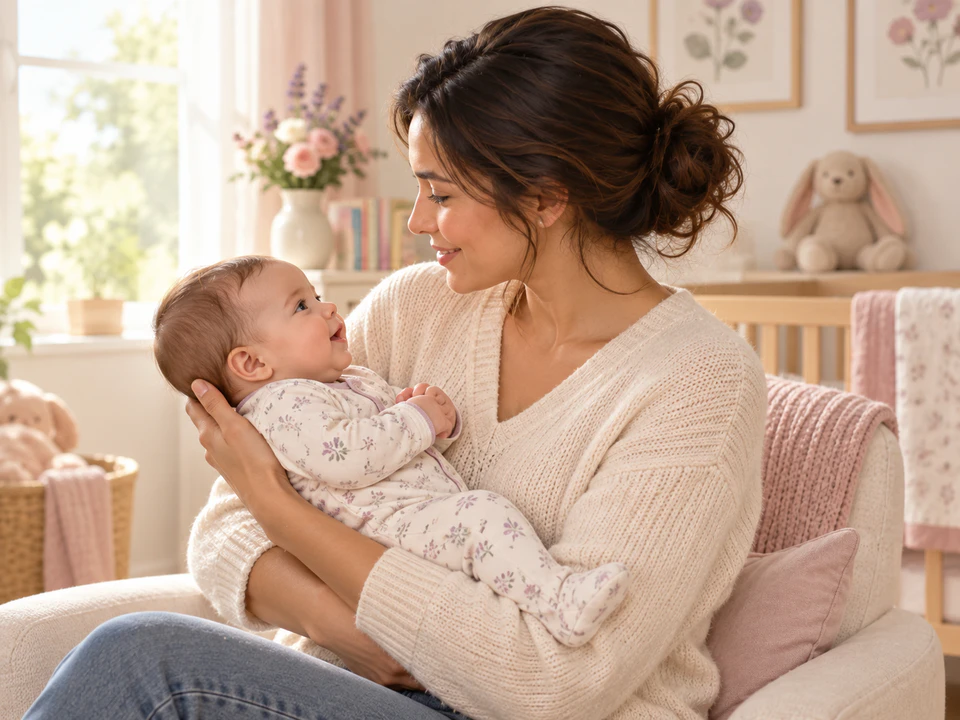
Talking and singing softly to a baby are worthwhile long before words make sense. Babies become familiar with voices, listen to their rhythms and have opportunities to respond in their own way. This exchange becomes easier to notice over the early months: looking towards faces may be apparent in the first month, smiling back more often in the second, and more pronounced vocal responses around the third. These are not deadlines against which to assess a baby each day. The timing and sequence of responses vary. One baby may settle on hearing a familiar voice or seeing their mother approach, even stopping crying before being picked up. Another may need further comfort. Eye contact, smiles and taking turns making sounds show that babies are participants in a relationship, not merely recipients of care. During the first year, these simple exchanges become some of the earliest forms of shared play.
How early experiences help children understand their world
Not being able to describe an early memory later in life does not mean a young child noticed or learned nothing at the time. From their first days, babies listen, watch, touch, move and become acquainted with their own bodies. Their senses help them explore objects, people and changes around them. Much of this learning happens naturally during ordinary care: feeding, washing, changing, talking and playing. Parents do not need to fill every moment with a specially planned developmental activity. It matters more that everyday life offers enough enjoyable contact and opportunities to explore, with stimulation suited to the child's abilities. Watching carefully helps an adult recognise when a baby wants an interaction to continue and when a pause would be welcome. Learning can then remain part of a responsive relationship rather than a task to complete regardless of how the baby feels.
Learning what to expect from ourselves and others
A cry, a facial expression or a movement is a child's attempt to communicate. When an adult notices and tries to respond, the child repeatedly experiences their needs as something that matters. Over time, these encounters support an expectation that familiar people can be relied on and will offer help. A sense of being worthy of attention and love also begins to develop. In psychological terms, an early view of the world includes just such expectations: can I trust other people, will someone be there when I struggle, and am I worthy of closeness? A baby cannot yet put these questions into words; they reflect what relationships teach the child about themselves and their surroundings. Early experiences can have lasting significance for confidence, relationships and a person's understanding of their own abilities. They are not an unchangeable verdict on the future, however. They provide an important developmental foundation, not a claim that one response or one missed moment determines an entire life.
Love that does not depend on achievement
Children need to experience belonging and love even when they fail, make a mistake or behave differently from what adults expect. Acceptance of this kind supports self-esteem that does not depend entirely on obedience, praise or other people's approval. As children mature, it can help them understand that praise concerns something they have done well, while criticism concerns an action they can change; neither determines their value as a person. Early emotional security therefore matters both for a child's relationship with themselves and for their ability to form close relationships later. Dependable attachment can be protective in mental health and psychosocial development, but it cannot guarantee a life without difficulties. Even the most attentive care cannot rule out every psychological or developmental problem. Its importance lies in supporting trust, emotional resilience and the ability to face challenges, not in promising that challenges will never arise.
Closeness does not require constant self-denial
When emotional needs are presented as a long list of demands, parenting can feel like work in which enough is never enough. Real relationships develop more gradually. Parents get to know their baby's responses and build a sense of what suits them; intuition can be useful when it goes hand in hand with observation and a willingness to adjust. Some sacrifices are unavoidable, and some children need more adaptation than others. Where there is a choice, however, closeness need not depend on an activity that makes the adult uncomfortable. A mother or father who does not enjoy giving a massage can sing, talk, carry their baby or play instead. The activity should work for both the baby and the caregiver. Enjoyment on both sides is not an unnecessary addition to good care. It can help keep the relationship warm and prevent every encounter from feeling like another duty the parent has to endure.
Responding to crying is not spoiling
Infants cry to communicate a need or discomfort. When an adult approaches and tries to soothe them, the baby experiences their call reaching someone who will help. Other invitations deserve attention too: a smile, a look, a sound or a movement seeking interaction. During the first year, gentle comfort and meeting a baby's needs should not be mistaken for excessive indulgence. Babies have not yet developed the ability to settle themselves in every situation and rely heavily on adults. Warm, responsive care is therefore not at odds with later independence. It offers the experience of a dependable relationship from which a child can gradually explore. Responding does not mean a parent must always identify the reason for crying immediately or successfully stop it. What matters is the effort to understand the baby and the repeated experiences of availability through which attachment grows.
Why attachment matters
Human connection is not a minor part of life. Psychological traditions have explained motivation in different ways: Freud placed particular emphasis on drives, while approaches centred on relationships highlight the need for closeness and contact. These historical differences help explain why connection is considered a fundamental need rather than simply a consequence of having hunger satisfied. The distress of isolation, including solitary confinement as a punishment, illustrates how painful a lack of human contact can be. For a baby, closeness also serves an immediate protective purpose. Babies cannot obtain food, remove dangers or arrange their own care. Staying near someone who can do those things increases their chance of receiving help. From an evolutionary perspective, it therefore makes sense that a child tries to maintain proximity and may become deeply upset when that person moves away. Seeking contact is not a weakness; it is part of a relationship in which the need for protection and emotional closeness develop together.
Security can grow with more than one caregiver
The central role mothers often have does not mean that biological motherhood alone determines who can give a child security. Fathers and other close caregivers can also become people a child turns to for comfort and protection when they are consistently involved, attentive and emotionally available. Continuity, warmth and sensitivity to needs matter, and children can form several such relationships. Dependable attachment supports emotional, intellectual and physical development. A severe, sustained lack of care, closeness and appropriate stimulation may be associated with difficulties in speech, movement, learning and general health. This is not a description of occasional parental exhaustion, nor a reason to attribute every developmental difficulty to family relationships. Many biological and life circumstances influence development and later health. Stable attachment may reduce the risk of certain emotional and behavioural difficulties, but it does not eliminate the possibility of later violence, addiction, delinquency or other serious problems.
A mother's bond does not have to appear all at once
The idea that giving birth instantly fills every woman with boundless love can be painful for a mother whose experience is different. Feelings after birth may be complicated, and closeness may grow slowly. Mother and baby are only beginning to know each other. Through care, shared time and adjustment to a new role, the mother learns to recognise her baby's responses, and their relationship becomes increasingly familiar and personal. Not feeling a powerful bond at the first meeting does not, on its own, mean something is wrong with her. She does not need to perform an emotion she has yet to feel or continually measure her experience against other people's accounts. There needs to be room for the relationship to develop, alongside support that makes everyday life more manageable. Her feelings towards the baby and the care she gives can grow together, without an expectation that everything will be fully formed immediately after birth.
Difficult feelings need room to be spoken about
Under strain, a mother may experience anger, frustration, aversion or feelings she finds hard even to acknowledge to herself. Social images of motherhood that emphasise love, happiness and sacrifice can make those experiences still harder to discuss. Silence does not ease the burden. A conversation without judgement, whether with a partner, family member or professional, allows her to describe what is happening and receive support rather than be labelled a bad mother. Help matters both for her and for her relationship with the baby. If she feels strong urges to harm herself or her child, she should seek professional help immediately; an immediate danger requires emergency help. Such situations should not be dismissed with instructions to calm down or be grateful. Understanding and timely support can help her manage the strain and gradually build a closer, more secure relationship with her child.
Every baby brings their own temperament
The baby, the adults and their circumstances all influence the relationship. Babies differ in their needs and responses from the beginning: the amount of touch, play or conversation one enjoys may overwhelm another. Some cry often and for long periods, while others are quieter. Some settle readily; others are hard to soothe even when a parent patiently tries several approaches. Sucking and feeding vary too. Breastfeeding may go smoothly for one baby from the start, while another struggles to latch, has a different appetite or feeding rhythm, refuses feeds or vomits more often. Sensitivity to light and sound also differs. A parent who reduces stimulation for a sensitive baby may be responding appropriately, even if an observer thinks they are overindulging the child. Preferences for affection vary as well: some babies enjoy prolonged physical contact, while others clearly signal when they have had enough. Understanding these differences means finding contact that suits this particular child rather than expecting every baby to respond alike to the same care.
Helping the parent can help the baby
A baby's behaviour also shapes how capable a parent feels. Confidence and satisfaction may come more easily with a baby who sleeps calmly, feeds well and grows steadily. Prolonged crying, feeding difficulties and broken sleep can instead leave a mother exhausted and convinced she is doing everything wrong. When she feels tired and discouraged, she has less energy to try again, even though her baby's needs may be particularly demanding. Some babies have complex needs that parents cannot easily understand on their own. In these circumstances, support from the father, family, doctors, developmental specialists and others involved is far more than a welcome extra. It can give the parent a chance to rest, understand the baby better and regain confidence. Sometimes the most important step for a baby's wellbeing is to help the adult caring for them, so that the adult can continue responding with greater confidence and less isolation.
Reading a baby's cues takes practice
Understanding what a baby is trying to communicate is not a fully developed skill every parent has on the first day. It grows through observation, attempts and shared experience. Being available and responding without unnecessary delay helps, as does being willing to adapt when the baby's rhythm changes. A rigid expectation that each day should follow a predetermined schedule can easily become a source of tension. Patience and resourcefulness are needed when something that soothed the baby yesterday no longer works today. Trying a different approach is more useful than concluding that the relationship is failing. All of this becomes harder alongside health concerns, emotional strain, family difficulties or financial worries. A mother's capacity to give attention to her child cannot be separated from the support she receives herself. Understanding from a partner, family and community can make the everyday responsiveness that benefits the baby more manageable.
Families need support and genuine choices
The quality of a relationship does not develop independently of living conditions. Security and the ability to arrange care around a family's needs matter to both parents and children. One mother may prefer to stay at home for longer during the early years; another may want or need to combine parenting with work outside the home sooner. Neither choice, by itself, tells us how much she loves her child. Presenting one arrangement as the only correct option ignores differences in families' resources, wishes and responsibilities. Decisions should not be driven by unnecessary pressure, and they need to be supported by practical help and dependable care for the child. When parents have more scope to make workable choices, they can more readily organise daily life without treating children's and adults' needs as being in constant opposition.
Attachment and learning to be apart
Closeness does not mean a child must remain beside a parent all the time. Growing up involves meeting other people, discovering new places and having experiences beyond the family's immediate protection. Separation can hurt at any age, but young children often feel it especially strongly: they cannot yet meet their own needs and do not always understand that an absence is temporary. Calling for a parent, crying or clinging are ways of trying to stay near the person who provides protection. At the same time, gradually widening experience is important for independence and personal development. The aim is not to eliminate every goodbye, but to help children manage separation in ways that reflect their age, maturity and previous experiences. Independence is easier to develop when a new experience is supported by a familiar relationship, rather than when closeness is withheld to make a child toughen up.
When separation anxiety becomes more noticeable
Distress when a familiar person moves away usually becomes more noticeable between six and eight months. It can continue through early childhood, for some children until around the age of four, with reactions often particularly strong between six months and two years. These age ranges are not a timetable every child must follow or a dividing line between typical and atypical development. Intensity and duration vary considerably. One baby may accept a short stay with a familiar caregiver fairly readily; another may protest and need longer. Circumstances matter too: who stays with the child, how familiar the surroundings are, and what earlier separations were like. Understanding the developmental need for closeness helps adults avoid mistaking fear for disobedience. Support can then be tailored to the child rather than based on an expectation that they should respond as another child does.
Being present is not always the same as being available
A parent can be in the same room as a child and still struggle to respond to physical or emotional needs. Prolonged depression, illness, serious conflict between partners or within the family, financial strain and certain mental health or personality difficulties may affect availability. That does not mean a diagnosis amounts to neglect or tells us what someone's relationship with their child is like. What matters is the care actually provided and the support available to the family. Physical separation, emotional unavailability and neglect should not be treated as interchangeable. A child may receive warm, reliable care while a parent works, just as a child may feel a lack of closeness with an adult who is physically present. Distinguishing these situations makes it possible to address what is genuinely missing, without automatically blaming parents for illness or difficult circumstances.
Why some separations become particularly difficult
A child's temperament, past experiences and close relationships shape their response to separation; similar patterns are sometimes seen in several members of a family. A parent's own experience of parting can matter too. Adults generally learn, little by little, when more protection is needed and when to allow another step towards independence. Persistent worry about safety can, however, turn into restricting almost every independent attempt. A child who senses that fear may also begin to see the world as dangerous and feel less secure with peers and other adults. In more pronounced cases, even a brief absence is difficult for the child, while the parent feels unable to let them out of sight. This can make independence harder, but it is not a reason to blame either person. A father or another familiar caregiver can gradually take on some of the care, helping the child develop trust beyond the relationship with their mother.
Pushing independence too early does not remove fear
The opposite difficulty arises when a child is expected to stop needing closeness as early as possible. Parents may believe they are preparing the child for life or preventing spoiling, and introduce separations before the child is ready. An experience that asks too much need not lead to greater independence; it may increase fear and insecurity instead. Managing time apart depends on more than the length of an absence. The child's abilities, familiarity with the caregiver and support in the new setting all matter. Taking things gradually is not the same as giving up on development. It allows children to meet challenges they can manage and build new confidence on what they already know. Withholding parental closeness does not, in itself, teach a child how to handle their feelings.
Responses to difficult or prolonged separation
Between roughly six months and four years, separation in unfamiliar surroundings can provoke particularly strong responses. A hospital stay, starting nursery or preschool, and other changes differ in their circumstances and severity; they should not all be treated as the same experience. Accounts of especially difficult or prolonged separation describe protest, despair and apparent adjustment. These patterns can help identify different ways distress is expressed, but they are not compulsory stages every child passes through. They do not necessarily occur in the same order or last for the same length of time. Behaviour needs to be understood in the context of the actual situation and the care a child receives. A single episode of crying, withdrawal or calm parting does not justify conclusions about attachment or psychological wellbeing.
Protest and searching for a parent
Strong protest may be a child's first way of showing the wish to reconnect with a parent. The child cries intensely, seems restless and keeps looking for their mother or another close caregiver. They may reject other adults' comfort, refuse to play and show less interest in food. In some situations described, this response may last around seven days, but that figure is neither a deadline nor a rule for assessing an individual child. Duration depends on the circumstances, available support and the child's characteristics. It helps to recognise what the protest expresses: a need for renewed contact and protection, not an intention to make life harder for adults. A calm, attentive response from another familiar person remains important even when the child does not accept comfort straight away.
Withdrawal after intense protest
When separation continues, some children protest less openly but become sad, withdrawn and less interested in their surroundings rather than relieved. Accounts of these circumstances describe a possible duration of around one week to three months, with substantial differences between children. This is not a universal course or a diagnostic time limit. Night-time fears, nightmares or a temporary return to earlier behaviours may appear. A child who had gained bladder or bowel control may have accidents again, begin using baby talk or suck a finger or thumb. Seeing a parent can sometimes trigger renewed crying and protest. This does not show that the visit is harmful or justify stopping contact. Maintaining relationships with familiar people may ease feelings of abandonment and help the child stay connected through a difficult period.
A calm appearance may not tell the whole story
After a particularly stressful or lengthy separation, a child may stop crying, begin communicating and accept other people. This can look like adjustment, but an absence of protest alone does not prove the distress has passed. Some children remain indifferent, withdrawn or less willing to show feelings. On reunion, they may seem not to notice a parent, reject contact or appear not to recognise them. That can be painful for the parent and raise fears of having been forgotten, although a reunion response alone should not lead to that conclusion. Repetitive self-soothing behaviours, such as rocking the body or head and sucking a thumb, sometimes occur. These descriptions concern serious and prolonged separations. They should not be expected after every day at nursery, and temporary withdrawal or an isolated movement should not be interpreted as evidence of severe emotional harm.
Work, parenting and guilt
Working parents often try to balance their jobs, home and time with their children, only to feel guilty because no part of the day looks quite as they hoped. They may be exhausted after work, shared activities may be shorter than they would like, and household tasks may remain unfinished. The time when they cannot give their child direct attention can weigh on them too. Worry may become irritability or low mood and affect how they interact. Yet whether a mother is employed is not, on its own, a reliable indicator of parenting quality. Her satisfaction with her circumstances, sense of security and available support matter. A woman who feels supported may have more patience and understanding whether she works outside the home or stays at home. When parents work, dependable care during their absence is essential: someone who knows the child, responds to their needs and helps them feel secure.
Making up for absence does not mean removing boundaries
Guilt can lead a parent to do more than a child needs: taking over tasks the child can already manage, providing excessive help or even doing schoolwork for them. A parent may buy too many toys, try to fulfil almost every wish, drop boundaries or feel sorry for the child because they are not always together. Compensation of this kind can reduce opportunities to practise independence and tolerate frustration. A child who rarely has to wait, accept a refusal or try solving a problem may struggle more when things do not go their way and remain overly focused on their own wishes. If the pattern persists, expecting others always to accommodate them can strain later relationships. This is not an inevitable result of parents working, nor a prediction for every child who receives presents. What matters is how adults handle guilt and preserve reasonable expectations, boundaries and room for the child to do things independently alongside their love.
Time together: quality and quantity both matter
Time together offers more when parent and child are genuinely involved in what they are doing. A short game, a conversation, an age-appropriate household task or another activity both enjoy can provide real connection. Emphasising quality does not mean quantity is irrelevant, however, or that a few focused minutes can always make up for absence. In a busy day, parenting can easily become something fitted between other obligations. Even free time sometimes turns into driving from one organised activity to another, with other adults doing most of the interacting with the child. It is worth protecting some unstructured time when the family can simply be together. Closeness does not always require a special outing or developmental exercise. It needs opportunities for parent and child to talk, notice each other and share an ordinary part of the day.
What shapes a child's experience of separation?
The same length of time apart does not create the same experience for every child. Age, temperament, previous separations, relationships with parents and what happens during the absence all matter. Children under four may find it especially difficult to enter unfamiliar surroundings and stay with someone they do not know well or cannot reliably depend on. Younger children generally need more immediate support, but age is not the only consideration. Ordinary daily separations, with good care from another person and stable family relationships, need not have significant adverse effects on later psychological development. The initial protest may be intense yet temporary. Any assessment should therefore consider the child's whole experience, not just how long they cry at departure. This makes room both for the difficulty they are having and for the possibility that, with support, they will gradually feel comfortable in the new setting.
Changes that may follow a separation
After a separation, some children become more irritable or defiant, or have more tantrums. Others withdraw, behave more aggressively or act destructively. Sleep and feeding may change, and previously established bladder or bowel control may temporarily become less reliable. Stomach aches, headaches, nausea, tiredness, exhaustion or changes in speech sometimes appear too. None of these signs alone proves that separation is the cause, but they are worth noticing and considering alongside the circumstances. A heightened fear of the next separation can be a common response. The child may want to stay beside their mother constantly, resist even brief absences and repeatedly seek reassurance that she is there and loves them. Their behaviour may suggest uncertainty about whether a familiar person will return. Recognising this possible insecurity helps adults see the underlying need, not only the demands being made.
When fear and exhaustion feed into each other
A child afraid of another separation may seek almost continuous attention and react strongly to any wait. A loving, understanding parent can still become exhausted, frustrated and angry over time. If the child experiences that anger as rejection, the need to keep checking the parent's love may grow. A cycle can develop in which increasing demands for closeness create tension, and that tension prompts further demands. A relationship may contain deep attachment alongside frequent conflict, insecurity and fatigue. Recognising this pattern does not mean fulfilling every wish immediately. It helps adults avoid reading every demand simply as disobedience and notice their own need for support as well. Understanding the fear can change the way a parent responds, even when the boundary itself stays the same.
When separation carries greater emotional risk
Repeated, lengthy or especially difficult separations may increase the risk of more serious difficulties. Particular concern arises when a child has already experienced strained or insecure relationships, is more sensitive in their responses, or faces separation alongside illness, war or other highly stressful circumstances. Such experiences can be traumatic and affect trust, security and willingness to form new relationships. A child may become more guarded, expecting further disappointment; in the most severe circumstances, serious emotional and psychological difficulties may develop. Several months without any contact with parents deserves particular attention. An absence of around five months without contact may be associated with longer-lasting changes in experience and behaviour, but it is not a universal threshold beyond which consequences can be predicted. Counting months cannot replace consideration of the quality of alternative care, the earlier relationship, the child's characteristics and the way contact is restored.
Rebuilding closeness after years apart
A long separation can make relationships difficult even when another person has cared well for the child during the parents' absence. This happens, for example, in families where parents work abroad and live apart from their children for years. Reunion may bring much better material circumstances, but it does not automatically restore earlier closeness. Emotional distance, misunderstandings and difficulty connecting in daily life may remain. A young child cannot yet grasp all the financial and family reasons for leaving. They may interpret the absence personally, as though their parents would have stayed if they had mattered enough or been loved enough. That experience does not necessarily reflect the parents' actual feelings, but it can be deeply painful for the child. Living together again may therefore require patience, time and a gradual rebuilding of trust, rather than an expectation that improved circumstances will immediately remove emotional distance.
Planning time apart while keeping care consistent
Before a planned separation, consider the child's age, earlier responses and who will take over their care. Where there is a choice, unnecessary lengthy separations in the earliest years are best avoided. If an infant or young child, particularly one under three, must be apart from both parents, it is preferable to keep the absence as short as feasible, use familiar surroundings and arrange care with someone the child already knows. That person's calmness, patience, emotional stability and ability to respond to needs matter. Continuity allows trust and closeness with the caregiver to develop through repeated contact. Frequent changes of caregiver can make adjustment harder because the child has to learn each new person's responses again. These suggestions do not require families to avoid every necessary absence. They are ways of preserving as much familiarity, reliability and supportive connection as circumstances allow.
Staying connected during a hospital stay
When a child is in hospital, a parent staying with them and regular visits can ease separation stress. Spending part of the day together or maintaining direct contact as far as circumstances permit also has value. Leaving after a visit may bring intense crying and protest, which can be especially hard for parents to witness. That response does not, in itself, mean the meeting was harmful or that further visits should be missed. Crying may express sadness because the child wants the parent to stay. An adult's calm response, acceptance of that sadness and continued contact help prevent a parting from becoming a break in the relationship. Visits and stays need to fit the family's circumstances and hospital rules, while preserving whatever closeness is possible rather than assuming a child is better without it because they protest afterwards.
Preparing for nursery or preschool
Starting nursery or preschool changes more than a parent's presence. A child meets a new place, adults, peers, rules and daily routines. Gradual preparation can help make this new life less unfamiliar. Before the first day, parents can visit with the child, spend time in the nursery playground or show them where they will be, as the setting allows. It helps to describe what to expect realistically, without promising that every moment will be fun. A parent might explain that the child will go during the day, rather as the parent goes to work, and will play, meet other children and gradually make friends. This gives the child a basic understanding of the change without asking them to love everything new straight away.
A calm, clear goodbye
At departure, it is important to say goodbye, make it clear that the parent will return, and then leave without prolonged hesitation or drama. Drawing out the parting can increase tension, especially when a child is already worried and watching every change in a parent's expression or decision. Being clear is not the same as being cold or demanding that sadness stop. A parent can acknowledge the difficulty and remain warm while still bringing the goodbye to an end. The aim is not to prove that crying is pointless, but to help the child recognise a predictable sequence: a goodbye, time with another dependable adult and the parent's return. This respects feelings without turning every departure into an uncertain negotiation.
Building up time in the new setting
If family circumstances and the nursery's arrangements allow, early visits can be shorter, lasting a few hours and mainly covering playtime. Meals and naps can be introduced later, once the child knows the surroundings and people better. Sleeping in an unfamiliar place is particularly demanding for some children, and an established sense of security may help. This is not the only possible settling-in plan or a rule every family can follow. The pace needs to suit the individual child and setting. It can also help for the child to see a parent having a friendly conversation with their caregiver: the encounter can convey that this is someone the parent trusts. As familiarity, relationships with staff and connections with other children develop, longer stays may become easier to accept.
What childcare staff need to know
Trust between parents and childcare staff also grows through sharing practical information. It helps to describe the child's habits, feeding and settling routines, health and usual sources of comfort. Earlier separations matter too: how the child reacted, what helped and what was especially difficult. Family circumstances affecting mood, strong jealousy or other emotional difficulties can help a caregiver understand behaviour that might otherwise seem puzzling. When adults work together, a child is more likely to receive a response suited to their needs in the new environment. Growing trust in caregivers and friendships with other children may then make longer stays easier. Cooperation is not simply a one-off conversation before the first day; it is a way for parents and the setting to keep track of how the child is actually experiencing the change.
When starting childcare coincides with changes at home
What happens at home also shapes the meaning a child gives to nursery. If relationships are tense, they may mistakenly see being sent there as a punishment or a sign that their parents do not want to be with them. Starting soon after a younger sibling is born can be particularly sensitive. Alongside jealousy, an older child may conclude that they are being sent away so the parents can be alone with the baby. That may not reflect the parents' intentions, but it deserves recognition. Where circumstances permit, a later start or a more carefully planned settling-in period may be worth considering. If delaying is not possible, understanding the family context and working with childcare staff remain important. The point is not that every change inevitably causes difficulty, but that several changes at once may mean a child needs more support.
Parents may need time to feel confident too
Sometimes a parent finds the separation very hard as well. Worry about how the child will feel, whether someone will understand them and how they will cope can show in a parent's voice and behaviour. A child may notice the tension and feel less secure, but that is not a reason for parents to blame themselves for feeling anxious. Getting to know the setting, the people providing care and how things work is more useful, allowing trust to rest on a real understanding of the environment. For many children, nursery becomes a place of important social experiences and happy memories, although not everyone settles at the same pace. When a parent develops well-founded confidence in the care offered, it becomes easier to support the child calmly. Questions and a need for information are part of that process, not evidence of parental failure.
When crying and reluctance to attend continue
Crying at goodbye is common at first, but understanding adjustment means finding out what happens after the parent leaves too. Staff may explain that the child soon settles, starts playing and joins other children. For many, protest gradually eases as the place and people become familiar. Punishment or excessive strictness may silence protest without reducing fear, and a child may feel their emotions are no longer accepted or that leaving costs them their parent's affection. Repeated promises of presents do not necessarily resolve the difficulty either: demands may grow while the fear remains. Patience, consistency and understanding matter more, along with attention to the whole day rather than only the goodbye. Settling in sometimes takes around a week and, for some children, several months. Temperament, relationships with staff, family circumstances and care arrangements all influence it. This range is not a reason simply to wait through prolonged suffering. If a child persistently cannot settle, the causes and the need for additional support deserve closer consideration.
Independence supported by closeness
Even with preparation and attentive care, some children resist nursery for a long time. This can exhaust the family and intensify a parent's wish to protect them from every uncomfortable experience. Growing up nevertheless involves change, frustration and circumstances that cannot always be avoided. Adults cannot remove every difficulty; their role is to help a child gradually learn to manage it. That calls for a balance between protection and room to try. Children need to feel that support does not disappear when they enter another setting or attempt to solve a problem themselves. An adult's confidence in their abilities, respect for their feelings and available help can make that step easier. Closeness and independence need not compete. A dependable relationship may be precisely what gives a child enough security to meet other people, explore and act with growing independence.